Mental health conditions such as depression and obsessive-compulsive disorder (OCD) can significantly affect a person’s daily life, relationships, work, and overall well-being. While medications and psychotherapy remain important treatment options, some patients may not experience sufficient improvement or may have difficulty tolerating medication side effects.
This is where Transcranial Magnetic Stimulation (TMS) and Deep Transcranial Magnetic Stimulation (dTMS or Deep TMS) may be considered.
Both are non-invasive brain stimulation treatments that use magnetic pulses to influence activity in specific areas of the brain. However, the technology, coil design, treatment targets, and depth and breadth of stimulation can differ.
If you are wondering what is the difference between TMS and dTMS, this guide explains the two treatments in simple terms and helps you understand what to discuss with a qualified mental health professional.
What Is TMS?
Transcranial Magnetic Stimulation (TMS) is a non-invasive treatment that uses an electromagnetic coil placed near the scalp to deliver magnetic pulses to targeted areas of the brain.
In repetitive TMS (rTMS), repeated magnetic pulses are delivered to a specific brain region. The goal is to influence neural activity in areas associated with conditions such as depression.
TMS is performed without surgery, anesthesia, or hospitalization. A typical session involves sitting comfortably while the treatment coil is positioned against the scalp. Patients may hear clicking or tapping sounds and feel sensations around the treatment area.
TMS is commonly considered when standard treatments, such as medication or psychotherapy, have not provided adequate improvement.
What Is dTMS?
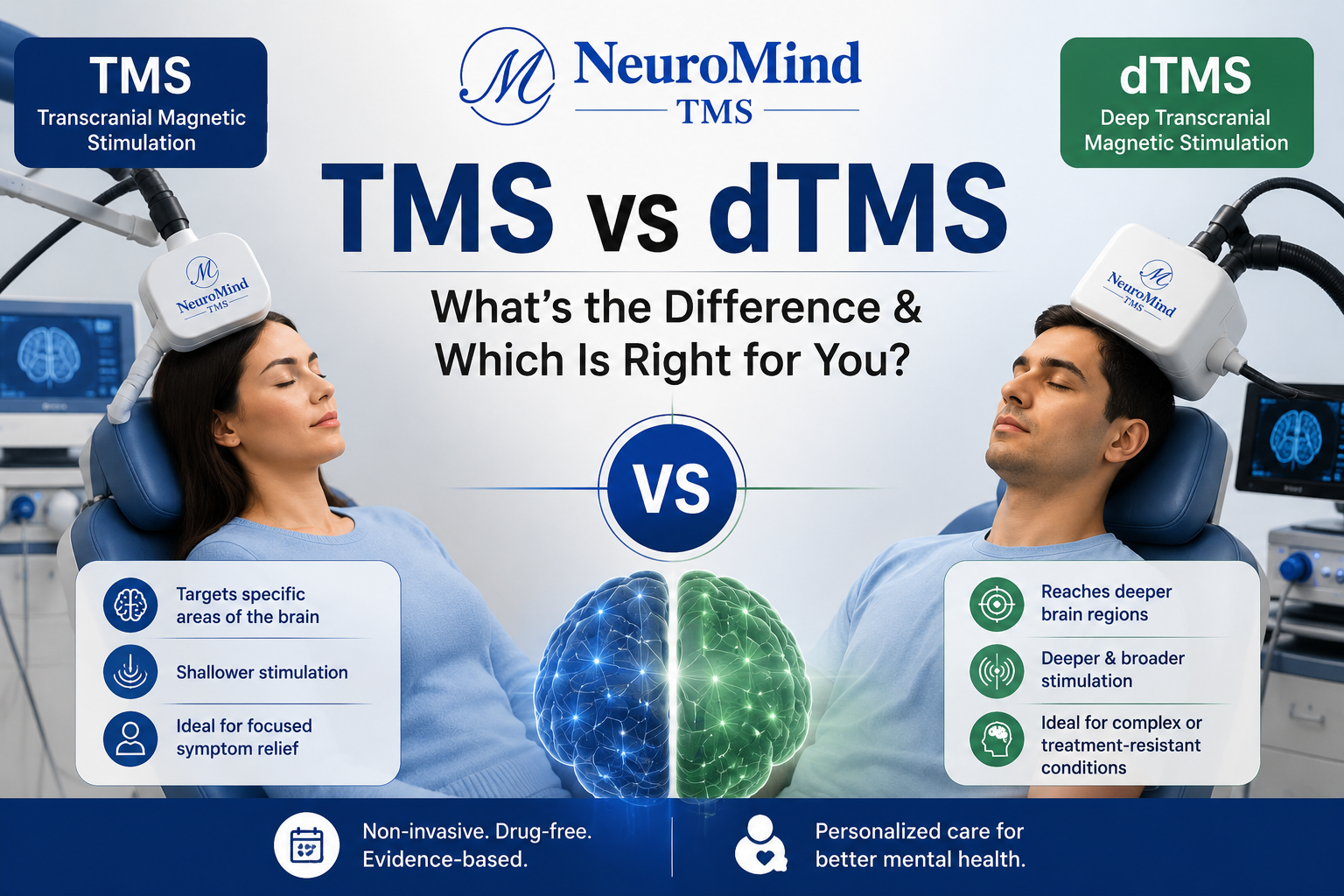
Deep Transcranial Magnetic Stimulation (dTMS) is an advanced form of TMS designed to stimulate deeper and broader brain regions.
Unlike conventional figure-8 TMS coils, certain Deep TMS systems use specialized coil configurations. For example, BrainsWay Deep TMS uses an H-Coil incorporated into a helmet-like device. The design allows magnetic stimulation to reach broader and deeper brain structures than conventional TMS coils.
Like standard TMS, Deep TMS is non-invasive and does not require surgery or general anesthesia.
Deep TMS has been cleared for specific indications in the United States, including Major Depressive Disorder and OCD, with additional indications depending on the specific device and regulatory jurisdiction.
TMS vs dTMS: What Is the Difference?
The biggest difference between TMS and dTMS is how the magnetic stimulation is delivered and the areas of the brain that can be targeted.
| Feature | TMS / rTMS | dTMS / Deep TMS |
|---|---|---|
| Full form | Transcranial Magnetic Stimulation / Repetitive TMS | Deep Transcranial Magnetic Stimulation |
| Treatment type | Non-invasive brain stimulation | Non-invasive brain stimulation |
| Stimulation | More focused stimulation | Designed for deeper and broader stimulation |
| Coil/device | Commonly uses a figure-8 or similar coil | Uses specialized coils; some systems use an H-Coil helmet |
| Anesthesia | Not generally required | Not generally required |
| Hospitalization | Generally not required | Generally not required |
| Treatment setting | Outpatient | Outpatient |
| Treatment suitability | Depends on diagnosis and clinical assessment | Depends on diagnosis, device indication and clinical assessment |
The choice between TMS and dTMS should not be based simply on which technology sounds more advanced. The appropriate treatment depends on the patient’s diagnosis, symptoms, medical history, previous treatments, treatment goals, and the technology available at the treating centre.
How Does TMS Work?
During TMS, an electromagnetic coil is positioned near the patient’s scalp.
The coil produces magnetic pulses that pass through the skull and stimulate nerve cells in a targeted region of the brain. Repeated stimulation may influence neural activity in networks associated with mood and other brain functions.
For depression, TMS commonly targets areas involved in mood regulation. The exact biological mechanisms through which TMS produces clinical improvement are still being studied.
How Does dTMS Work?
Deep TMS uses specially designed coils to produce magnetic fields capable of stimulating deeper and broader brain regions.
For example, BrainsWay’s H-Coil technology is designed to reach deeper brain structures while covering a broader area than first-generation TMS coils. Depending on the condition being treated, different coil configurations and treatment protocols may be used.
The treatment is still non-invasive. Patients remain awake during the procedure and generally do not require sedation or anesthesia.
Is dTMS Better Than Standard TMS?
There is no simple answer that dTMS is universally better than standard TMS.
Both technologies have clinical applications, and the most appropriate option depends on the patient’s individual condition and the treatment protocol recommended by a qualified clinician.
Deep TMS may offer an advantage when treatment requires stimulation of broader or deeper brain regions. However, treatment selection should be based on clinical assessment rather than technology alone.
A psychiatrist or trained TMS specialist can evaluate your symptoms and treatment history and determine whether TMS, Deep TMS, medication, psychotherapy, or a combination of approaches is appropriate.
TMS and dTMS for Depression
Depression is one of the most established clinical applications of TMS.
TMS may be considered for people whose depressive symptoms have not improved adequately with conventional treatments. It may also be considered when medication side effects or other factors make alternative treatment approaches appropriate.
Deep TMS is also used for Major Depressive Disorder under specific regulatory indications. The exact eligibility criteria depend on the device, country, and clinical circumstances.
Importantly, TMS is not a “one-session cure.” Treatment usually involves a planned course of repeated sessions, with the exact number and frequency determined by the treating clinician.
TMS and dTMS for OCD
OCD is another condition for which certain TMS technologies may be used.
The U.S. FDA authorized marketing of the BrainsWay Deep TMS System for OCD in 2018, providing another non-invasive treatment option for appropriately selected patients.
Deep TMS protocols for OCD can involve stimulation of brain regions associated with OCD symptoms and may include a brief symptom-provocation component as part of the treatment protocol.
However, not every TMS or Deep TMS system has the same regulatory indications. Patients should ask their treatment provider which technology is being used and for which conditions it is clinically appropriate.
What Does a TMS Session Feel Like?
TMS does not involve surgery or putting anything inside the brain.
During treatment, patients may hear clicking or knocking sounds and feel tapping or a pulsing sensation around the treatment area. Some people may experience temporary discomfort around the scalp or treatment site.
Deep TMS is similarly performed while the patient remains awake and seated. A helmet containing the treatment coil is positioned on the head before stimulation begins.
Your treatment team can adjust the treatment settings and positioning based on your comfort and clinical requirements.
Are TMS and dTMS Safe?
TMS and Deep TMS are non-invasive treatments, but like any medical procedure, they can have potential side effects and are not suitable for everyone.
Possible effects can include scalp discomfort, headache, or discomfort during stimulation. A qualified clinician should review your medical history and determine whether TMS is appropriate for you.
Patients should also inform their doctor about relevant medical conditions, medications, implants, or metal/electronic devices before treatment.
How Long Does TMS Treatment Take?
TMS is generally delivered as a course of repeated outpatient sessions rather than a single treatment.
The duration of each session and the total number of sessions can vary depending on:
- The condition being treated
- The TMS technology being used
- The treatment protocol
- The patient’s response
- The treating clinician’s assessment
Some Deep TMS protocols involve sessions of approximately 20 minutes, although treatment duration varies by protocol and device.
Your doctor will explain the recommended treatment schedule before therapy begins.
Which Is Right for You: TMS or dTMS?
There is no single treatment that is right for every patient.
A qualified mental health professional may consider factors such as:
- Your diagnosis
- Severity and duration of symptoms
- Previous medications and therapies
- Response to previous treatment
- Medication side effects
- Medical history
- Treatment goals
- The specific TMS technology available
- Whether the technology is indicated for your condition
Instead of choosing a treatment based only on the term “Deep TMS,” it is important to have a proper clinical evaluation.
TMS Treatment at NeuroMind TMS Centre
At NeuroMind TMS Centre, patients can explore non-invasive TMS-based treatment options under professional clinical supervision.
The centre focuses on providing personalized care for patients who may benefit from TMS-based brain stimulation as part of their mental health treatment plan.
Depending on the patient’s condition and clinical assessment, TMS services may be considered for conditions such as depression and other appropriate mental health concerns.
Before beginning treatment, patients undergo a clinical assessment to understand their symptoms, treatment history, and suitability for TMS.
If you or someone you know is considering TMS or Deep TMS, speaking with a qualified specialist can help you understand the available options and determine the most appropriate treatment approach.
Frequently Asked Questions About TMS and dTMS
Is dTMS the same as TMS?
No. dTMS is a form of transcranial magnetic stimulation designed to stimulate deeper and broader brain regions using specialized coil technology. Conventional rTMS generally uses a more focused coil configuration.
Is Deep TMS more powerful than regular TMS?
Not necessarily. Deep TMS is designed to reach deeper and broader areas of the brain. Whether it is more appropriate depends on the condition being treated and the patient’s individual clinical needs.
Is TMS painful?
TMS is generally well tolerated, although some patients may experience scalp discomfort, tapping sensations, or headaches. Your clinician can adjust treatment settings to improve comfort.
Does TMS require anesthesia?
TMS and Deep TMS are generally performed without general anesthesia or sedation. Patients remain awake during treatment.
Can I drive after TMS?
Because TMS does not generally require anesthesia or sedation, patients can often return to their usual activities after treatment. However, individual recommendations may vary, so patients should follow their treating clinician’s advice.
How many TMS sessions are needed?
The number of sessions varies according to the treatment protocol, condition, technology, and individual response. Your TMS specialist will recommend a treatment schedule after evaluating you.
Is TMS an alternative to antidepressants?
TMS can be an option for appropriately selected patients, particularly when conventional treatments have not provided sufficient benefit. Whether medication should be continued, changed, or combined with TMS is a decision that should be made with your treating psychiatrist.
Should I choose TMS or dTMS?
Neither treatment is automatically better for everyone. The appropriate option depends on your diagnosis, symptoms, previous treatment, clinical history, and the specific technology and protocol available at the treatment centre.
Take the Next Step Toward Personalized TMS Care
Considering TMS or Deep TMS for depression, OCD, or another mental health concern?
NeuroMind TMS Centre provides professional TMS services with an individualized approach to patient evaluation and treatment.
Speak with a qualified specialist to understand whether TMS may be appropriate for you.
Book a TMS consultation with NeuroMind TMS Centre today.
